
ERP – now or never?

What it really costs not to have ERP
Everyone keeps asking “How much does ERP cost?”, but the more interesting question is “How much does it cost not to have ERP?”. Not having an ERP is not a zero‑cost scenario – every day it quietly eats away time, money and energy. Without an integrated process management system, operating expenses are typically 20–30% higher because of duplicated work, overstocking and decisions made on incomplete, inaccurate or outdated data.
CRM/ERP statistics are even clearer: companies using such systems report around 57% revenue growth and up to 25% better customer retention, while those without them see their potential revenue growth shrink by as much as 245%. Postponing ERP often “saves” licence fees today, but steadily destroys productivity and customer relationships tomorrow.

Why companies delay the ERP decision
Many organisations never get as far as the conversation “Which ERP should we choose?”. They get stuck on “Should we even start at all?”. The usual arguments sound familiar: “Now is not the right moment financially”, “People are overloaded”, “This is not a good time for change”. From a human point of view that is understandable – but the business still pays the price. In the meantime, processes become more complicated, the chaos grows, and postponing the implementation only makes it more painful and more expensive later.
The core issue is that the decision is often made intuitively, not based on numbers. Rarely does anyone sit down and calculate how many hours per month are lost in retyping, searching, chasing approvals and fixing mistakes – and how that translates into money. When these numbers are missing, “let’s wait a bit longer” can sound reasonable. But it isn’t.
How to be confident you’re making the right ERP decision
Treat the ERP question as a concrete business case. In practice this looks like:
- Listing the main manual and fragmented processes – orders, invoicing, projects, warehouse, service, communication.
- Estimating how many hours per week go into them (by department) and multiplying by the real cost of labour – this gives you a baseline for the “hidden cost of chaos”.
- Identifying missed opportunities: slow quotes, lost customers, wrong or delayed reports, lack of control over projects and spending.
Then compare this picture with the expected effect of an ERP system, using realistic ROI benchmarks: an average 150–400% ROI over 12–36 months and payback often within 16–24 months. Once you see the numbers side by side, the question “Should we implement?” stops being abstract and it becomes clear whether you are actually losing more by waiting.
How to deal with doubts
Doubts are inevitable: “Will we block operations?”, “Will people adapt?”, “What if we choose the wrong system?”. Interestingly, ERP studies show that fear of implementation is one of the main reasons for postponement, even though, with a systematic approach, end results are generally positive.
Here are several practical ways to minimise doubts without endlessly delaying:
- Do the calculations described above.
- Set clear project goals – what exactly you want to achieve with ERP (shorter processing time, fewer errors, faster reporting, better control).
- Request concrete proposals from several vendors and ask specific questions tied to your processes and industry specifics. Get in touch with your shortlisted provider to discuss the best‑fit approach.
- Request a demo so you can see how well the system matches the way you work.
- Start with a pilot – a limited‑scope implementation for one process or department, so you can see real‑world impact without taking a big risk.
- Track the results against the KPIs you defined at the start.
When doubts are “translated” into numbers, scenarios and phases, they stop paralysing you and become a manageable, calculated risk.
Is there ever a “right moment” to implement ERP?
The most common misconception is that you need to wait for the “perfect moment” – a calm year with no crises or major changes. Reality shows the opposite: companies that make timely decisions about digitalisation and ERP tend to be more profitable, quicker to react and more competitive. Delaying, especially for core systems like ERP, builds up technical and organisational debt that comes back later with interest.
That is why the question is rarely “Should we implement ERP someday?”, but rather “How much longer can we afford to run without it?”. When you look at the decision through the lens of value and support it with concrete numbers, the answer is usually the same: it is smarter to start now – in a structured, phased way – than to keep paying the hidden cost of postponement for yet another year.
Let’s talk about how to support you on your ERP journey.
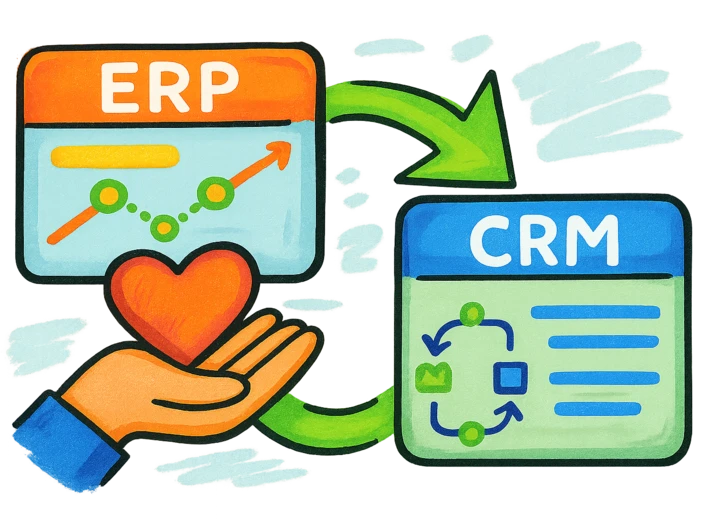
CRM vs. ERP? What is the Difference and How to Choose?
If your organization has previously implemented an ERP solution and you've held the belief that it will be the only system used within the company, you may want to consider what a sub-module of the ERP system is CRM and how to utilize it. The truth is that CRM is an entirely separate type of software system, and in a significant number of companies worldwide, ERP and CRM work in parallel, exchanging data to automate processes within the company.
24 October 2023
ERP vs. CRM?
If your organization has previously implemented an ERP solution and you've held the belief that it will be the only system used within the company, you may want to consider what a sub-module of the ERP system is CRM and how to utilize it. The truth is that CRM is an entirely separate type of software system, and in a significant number of companies worldwide, ERP and CRM work in parallel, exchanging data to automate processes within the company.
24 October 2023
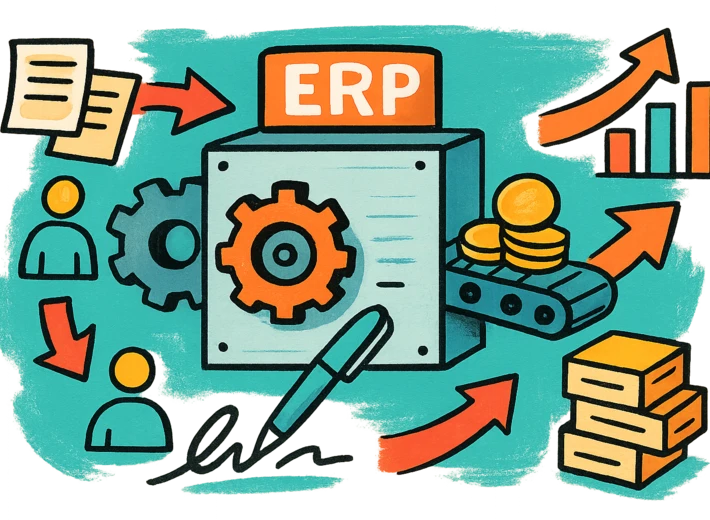
What is ERP and Does It Have a Place in My Company?
Lamborghini is a car, but so is a Zhiguli. There is a relatively detailed classification of software solutions for business management, and by some sadistic rule, most of them are abbreviations. If we check in the dictionary what ERP means, we will find that it is an abbreviation for Enterprise Resource Planning.
20 August 2025